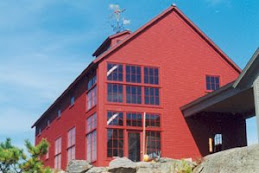
Check out the video about our house that Northeast Utilities produced for the CT Zero Energy Challenge. It was shown at the awards ceremony in Hartford on March 9th, 2011. Thank you, NU and the CT Energy Efficiency Fund for the award. Now we can afford to finish our master bathroom!
Saturday, April 2, 2011


Wednesday, February 9, 2011
Hibernation

 I've had several posts partially written, but the snow storms keep interrupting my writing. So why fight it, write about it.
Oh, to be a kid on a snow day...the eighth one this winter. Growing up in Oklahoma, I didn't get to experience that. I remember Tulsa getting 4 inches once when I was in high school, and that was a big deal, closing down the schools and most businesses. This year, Oklahoma has had two snow storms dropping record amounts of snow, over 24 inches in two storms occurring two weeks apart. If the weather of this past six weeks doesn't prove global warning, than I don't know what does. Increased temperatures affecting the amount of water taken up by warm air masses, that slam into cold, northern air, producing increased precipitation (icy rain, and yes, snow too).
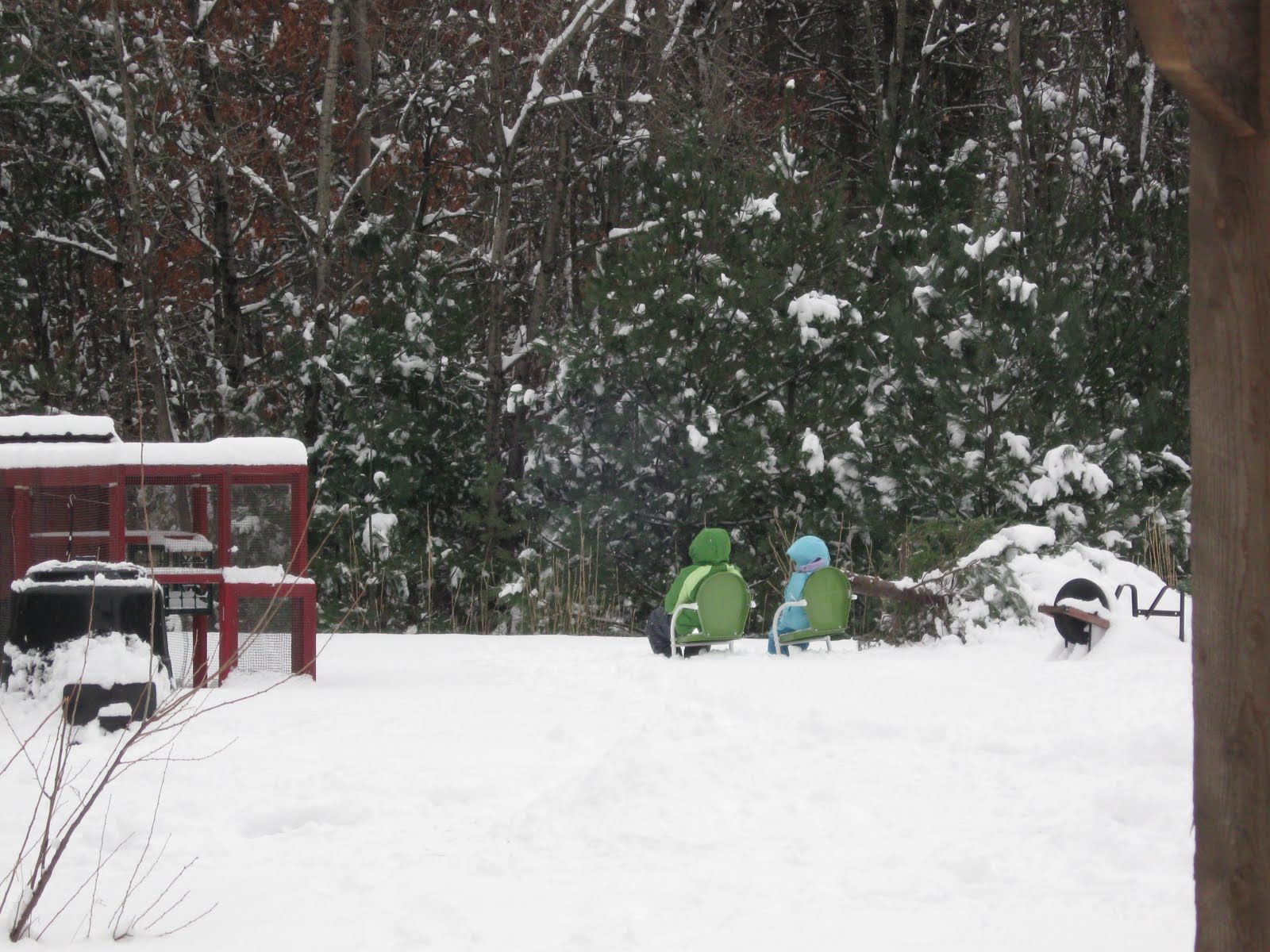
The picture on the right is of our kids sitting in small chairs after the first big storm (24 inches) in mid-January. Subsequent storms have completely buried the black compost bin and the chicken coop is barely visible now. The photo on the left is of our kids sitting on the top of our wood picnic table. In January we got 58 inches of snow and February is shaping up to be the same.
The shoveling kinda sucks but the snow has great insulating properties. I've noticed that our slab floor temperature is rarely dropping below 65F except on super cold days, 15F or lower. We usually keep it at 67F to 68F depending on how much sun we've had. However, I have experimented with letting the slab temp drop on cloudy days and use the backup electric heat to keep from burning propane for the radiant heat. On the occasions I let the floor temp drop, I found that it seemed to come to an equilibrium at 65F without any energy input. It's hard to tell for sure, but I think the snow is helping to insulate the foundation.
For anyone thinking of solar panels. Snow storms over 6 inches will likely require you to remove some snow from the panels. It's just too much to shed on its own, before the next sunny day comes. We put our solar thermal panels on the ground and I am so glad we did. We are able to remove snow easily so we can start making hot water (our evacuated tube solar collectors still produce hot water when it's cloudy, so we want to get them working again quickly after a storm). For our photovoltaic solar panels on the roof, we have this extension pole with a flat, soft, foam squeegie thing on the end that is great for pulling the stubborn snow patches down. Unfortunately, it still requires going up on a ladder, not my favorite thing to do.
On another note, our new batch of chickens are arriving in mid-April. The kids are excited to have cute fuzzy chicks for easter. Sadly, our old hens were picked off by predators late fall over a two week period. Word got out and they were attacked from multiple perspectives (hawk, fox, and possibly coyote). They were scheduled for culling anyway because they were getting too old to lay eggs, but I was hoping to teach my kids where chicken nuggets come from and not feed the local wildlife. I'm thankful for the "learning chickens" and I think our next coop and fencing design will be better, for both us and the chickens.
Saturday, December 11, 2010
It's Official! 2nd place in CT Zero Energy Challenge
On Wednesday the 8th I got the call from CL&P concerning the CT Zero Energy Challenge results and was congratulated for our second place finish. Not that it was a big surprise since everyone's HERS values were announced months ago and that's how the contest was judged this year (next year there are a variety of factors which greatly level the playing field).
Reviewing the 1st and 3rd place finishers, I can't help but pat ourselves on the back for achieving what we did on such a limited budget. The other winners' homes are obviously big budget undertakings that easily push (though I'm just guessing) into the million dollar range. We did ours for less than a third of that. They hired consultants, architects and specialty builders. Karann and I designed, planned, engineered (with over-the-phone consultations from a few sources) and finished the house ourselves. Our builder, Dave Nugent, kicked ass for sure but this was his first "green" house.
Their houses are big (4000 sq. ft. plus), high-end homes unattainable by most, which I think sets a bad example of "green" building. Ours is a modest (some would even say large, if you live in the real world) home at 2670 sq. ft. And I know $320k is still a lot of money but at least it's reasonable for a custom (near) zero energy home, especially since the return on investment is already paying dividends; our electric bill is non-existent ($16 service fee every month) and we've purchased two, 100 gallon tank-fulls of propane in the last year and a half.
Now don't take this like I'm down-playing the accomplishments of the other winners (ok, maybe a little bit) but I do respect that they're setting examples that hopefully their other rich neighbors may follow. Maybe this will set a whole new trend of "keeping up with the Jones". Every neighbor trying to make their home more energy independent than the next.
In the meantime, I hope Karann and I have inspired the average, middle-class person to use some ingenuity, take a little time, and put in some sweat equity to make an energy efficient home that, you too, can be proud of.
Reviewing the 1st and 3rd place finishers, I can't help but pat ourselves on the back for achieving what we did on such a limited budget. The other winners' homes are obviously big budget undertakings that easily push (though I'm just guessing) into the million dollar range. We did ours for less than a third of that. They hired consultants, architects and specialty builders. Karann and I designed, planned, engineered (with over-the-phone consultations from a few sources) and finished the house ourselves. Our builder, Dave Nugent, kicked ass for sure but this was his first "green" house.
Their houses are big (4000 sq. ft. plus), high-end homes unattainable by most, which I think sets a bad example of "green" building. Ours is a modest (some would even say large, if you live in the real world) home at 2670 sq. ft. And I know $320k is still a lot of money but at least it's reasonable for a custom (near) zero energy home, especially since the return on investment is already paying dividends; our electric bill is non-existent ($16 service fee every month) and we've purchased two, 100 gallon tank-fulls of propane in the last year and a half.
Now don't take this like I'm down-playing the accomplishments of the other winners (ok, maybe a little bit) but I do respect that they're setting examples that hopefully their other rich neighbors may follow. Maybe this will set a whole new trend of "keeping up with the Jones". Every neighbor trying to make their home more energy independent than the next.
In the meantime, I hope Karann and I have inspired the average, middle-class person to use some ingenuity, take a little time, and put in some sweat equity to make an energy efficient home that, you too, can be proud of.
Saturday, November 20, 2010
Best Green/Energy Efficient Home in CT!!
On November 9th, 2010, Jeremy and I attended the HOBI Awards (Home Building Industry Awards) sponsored by the Connecticut Home Builders Association. Our general contractor, Dave Nugent from Greenworks Builder, won the award for the "Best Green Energy-Efficient House" in CT for our house. It was exciting to see our house displayed on the huge screen in the banquet room at the Aqua Turf, where everyone was dressed to the nines and people we didn't even know where speaking of our house with the highest praise. The food wasn't too bad either. We were amazed by many of the award winners, and even the categories, "Best Spec House Over $6 Million" or "Best Custom Home Over 12,000 square feet". I am NOT kidding about these categories. Many homes had jaw-dropping details and it reminded me of the incredible wealth in this state. I guess a recession just doesn't effect people who can afford 12,000 square foot homes and the costs to maintain them. It's no wonder that the loudest gasp from the crowd occurred when the emcee was describing our house and stated that we built it for $125 a square foot. That budget likely barely covered the landscaping costs for some of the homes. Regardless of how out of our element we were, we enjoyed the night and were pleased that Dave won such a prestigious award.
Monday, October 4, 2010
A Boy and His Chickens

 After grad school I spent a summer as a volunteer park ranger in southeast Alaska. In addition to my ranger duties, I also spent two weeks as a replacement caretaker for a fishing lodge while the regular caretakers were on their honeymoon in the "lower 48". While there were many highlights and adventures that summer (the postcard perfect landscape, endless salmon fishing, numerous brown bear and moose encounters), I found myself most amused and enamored with the small chicken flock that pecked and scratched around the small cabin I stayed in. I guess without electricity and running water, you find entertainment in the simplest things. Since then, the idea of chicken ownership seemed to fit well into the plan of owning land and building a sustainable house. While I've never had any experience farming, nor aspired to be a farmer, the lure of fresh, salmonella-free eggs, and the nonstop entertainment of plump little red hens running free was overwhelming. So when the opportunity arrived to adopt 5 rhode island red hens, I took it. Jeremy helped me build a coop for the hens and, surprisingly, Oslo has become the primary chicken tender (hee, hee, nice pun). He's named every one according to personality (Beauty Queen, Reliable Runny, Stripe, Peta and Polka) and handles them as much as they tolerate. Oh, and we eat fresh eggs often. With everything we've accomplished with our house over the past year, I have to say that those little chickens pecking in my yard make me feel as if I've truly "arrived".
Monday, September 13, 2010
NESEA Green Building Home Tour
I wanted to mention two events happening in the next month. The first is the NESEA Green Building Home Tour on October 2nd from 10 to 4. Our house will be included on the tour and you can get more information at the NESEA website.
Also of interest is a Passiv Haus (Passive House) workshop sponsored by the Solar Energy Assoc. of Connecticut on October 9th at 2pm in Manchester, CT conducted by the New England Passive House Alliance.
I recently made a presentation to the Solar Energy Assoc. of CT on the design and performance of our house (my first Power Point presentation!) and I found the organization to be great source for information on renewable and alternative energy and energy efficient building. Their members include people from a broad range of backgrounds and disciplines including architects, engineers, builders, educators, activists, and students. Check it out!
Monday, August 9, 2010
A Case Against Geothermal
After being asked about a zillion times by a house tour participant where my geothermal system was, I decided it was time for me to clearly state my opinion of geothermal heating systems. As I said, this is only one persons opinion, and with any decision involving spending copious amounts of money, one should conduct thorough research, and talk to as many people as possible, while considering the backgrounds and motives of "experts" before proceeding.
We decided a geothermal system was not right for our house for the following reasons:
1) Cost. A geothermal system is going to run $25K plus (mostly higher) and that only includes wells, piping, pumps, etc. You still need ways to convert that 52F water to either heat or cooling for your house.
2) Limitation. As stated in reason one, you're only getting water to 52F, which is fine for cooling, but in our climate (Northwest Connecticut) we heat our houses much more than cool them, so you still are going to need energy to convert that 52F water. Most homes with geothermal use heat pumps to harvest the energy (via temperature differences). This is, obviously, a very simplistic way of looking at it, but it was pointed out to me by an engineer friend that it equates to running a whole-house refrigerator/condenser 365 days a year. Doesn't that seem excessive?? A well insulated house in CT should not require a whole lot of AC, so heating is your primary concern. In my subjective opinion, geothermal is better suited for mid-Atlantic states, where the AC is running more than the heat.
3) The conundrum. Geothermal systems use huge amounts of electricity to pump the water down and then back up the geothermal wells. The solution I hear THE MOST regarding this problem is "Well, you can just install more photovoltaic (PV) panels to offset the added electricity use and cost." Every time I hear this, I usually want to: A) scream, B) stifle a well rehearsed, but condescending explanation of the "less is more" sustainable building theory, described below, or C) ask "With who's money?" The later answer about who is paying is an interesting conversation in itself, because the current state of rebates in CT right now that include PV and geothermal systems means that lots of people are actually paying for these systems, not just the homeowner or home builder.
4) The less is more sustainable building theory. The whole idea of building more sustainably SHOULD BE to use less, being materials, energy, land, whatever, NOT to build systems that can operate your 10,000 SF mansion cheaper. People will likely call me un-American for this, but what the heck. Building smaller IS building greener. Smaller houses use less materials, use less energy, and are less expensive to operate and maintain. Hopefully, our fascination with purchasing lots of stuff that we don't need, and can't afford, and building houses to hold all this stuff is coming to an end, thanks in part to the Great Recession.
Case in point (Boy, I'm going to get in a lot of trouble for this one), the likely winner of the CT Zero Energy Challenge is a house that few people could afford to build and no bank would touch a mortgage for it. This is because so much money was spent on the renewables and heating and cooling systems, there is no way an appraisal would justify the costs. It has something ridiculous like 65 PV panels, many just to run the systems in the house including geothermal. The goal of the Challenge is to promote energy efficiency/green building and to show builders and homeowners that they can achieve net zero energy. How can you expand your mission when your poster project is so unattainable.
5) Matching the technology to the scenario. All the previous points notwithstanding, I do believe that geothermal can work correctly and efficiently under the right conditions in the right project, but the current craze for geothermal means the technology is being used in places where it is neither effective or beneficial. There was an article recently in the Waterbury Republican American newspaper in their Green Living weekly series (our house was featured one week) about a guy who recently installed geothermal. The article praised the system then ended with a breakdown of costs. I'm quoting numbers here from memory because I couldn't find the article online to verify my facts, so forgive me if I get my numbers wrong. He spent $28K for the system and the first two years didn't save anything due to electric costs (his costs actually went UP!!). So he spent more money for different pumps and to rework the system and achieved a savings of $1200 on the third year. The cost benefit analysis proves this technology was not a good choice for his home.
The geothermal craze won't end soon enough for me. Then maybe I won't have to explain that our geothermal system is located in the basement, then gleefully watch as the hapless fool looks for the basement door. Unfortunately, CT has started a geothermal rebate program that is fanning the flames of misinformation and the "experts" pushing these systems are drillers making fortunes on installing them, and don't care about operating costs for the homeowners. Such is life.
Subscribe to:
Posts (Atom)